
Plan a Chapel Hill Person Search
Start with geography, then preserve each useful identifier. Most Chapel Hill records belong to Orange County, whose offices are in Hillsborough. A smaller eastern part of town lies in Durham County. A Chapel Hill postal address alone does not settle which county holds a deed, tax account, case, marriage record, or arrest file. Check the parcel or the event location before treating a missing result as proof that no record exists.
A full name works well in the deed and court indexes. An address is often faster in parcel and historical directory tools. A phone number may point to an older numerical directory, while a business name can lead to a registered agent or assumed-name filing. Keep middle initials, dates, counties, PINs, book and page citations, and roles in a simple log. Those facts help avoid merging a student, property owner, voter, or court party who happens to share a common name.
- Choose Orange or Durham. Use the property map or the known event site instead of relying only on the postal city.
- Search the strongest starting record. Try a current owner search for an address, or a party-name index for a full name.
- Carry identifiers forward. A PIN can lead to book and page, while a case number can lead to the clerk's paper file.
- Check another dated source. Compare a deed, voter entry, directory, court filing, or newspaper from the same period.
- Ask the custodian when the web stops. Use the office terminal, mail route, library holdings, or a narrow records request.
Chapel Hill Records Search Offices
Three offices divide much of the local work. The Register of Deeds keeps land instruments and Orange County birth, death, and marriage certificates. The Clerk of Superior Court keeps civil, criminal, estate, divorce, foreclosure, and special-proceeding files. The Town Clerk handles Chapel Hill municipal proceedings and requests. North Carolina does not use one county clerk as the custodian for every type of record.
Call before traveling for an older volume or a certified copy. The town is not the Orange County seat, and the main deed and court counters are in Hillsborough. Durham County offices handle records tied to the Durham side of Chapel Hill.
Orange Register of Deeds
Gateway Center, 228 S Churton Street, Suite 300
Hillsborough, NC 27278
919-245-2675
Orange Clerk of Superior Court
106 E Margaret Lane
Hillsborough, NC 27278
919-644-4500
Chapel Hill Town Clerk
405 Martin Luther King Jr. Boulevard
Chapel Hill, NC 27514
919-968-2743
Note: Town records, county deeds, and court files follow separate request channels even when they concern the same person or address.
Orange Deed Records Search Since 1932
The Orange Consolidated Index was verified from September 1, 1932, through July 24, 2026. That online span is not the start of county land records. Older Index Books, Register of Deeds office holdings, Orange County Public Library microfilm, and the State Archives extend the trail far earlier. The web gateway also requires cookies and popups, and some plat images are described as unofficial viewing copies.
The Orange deed index source shows how a Chapel Hill name can be searched as an individual or firm.
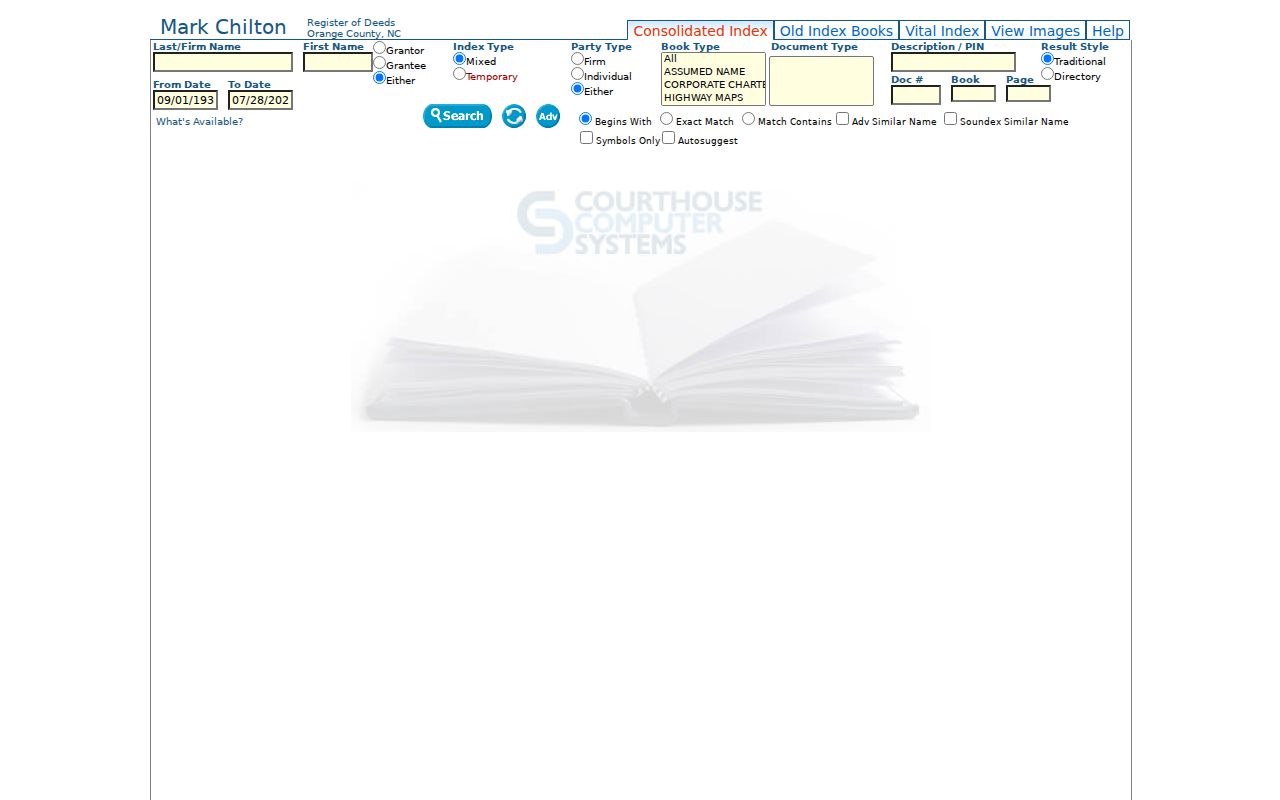
The many controls make it possible to narrow a common surname by role, date, document kind, legal description, or parcel PIN rather than accepting every loose match.
| Index field | Useful choice | Search purpose |
|---|---|---|
| Last or firm name | Begins, exact, contains, or similar name | Find people, organizations, and spelling variants |
| Party role | Grantor, grantee, or either | Separate parties transferring and receiving an interest |
| Date and document | Date range and instrument type | Narrow a long name list to the likely event |
| Description or PIN | Legal text or parcel identifier | Connect a person to a known Chapel Hill parcel |
| Book and page | Direct citation | Return to an instrument named in another record |
- Grantor
- A party who transfers an interest. The role does not always mean a simple seller.
- Grantee
- A party who receives an interest. The name does not prove that the person lived on the land.
- Index
- A finding tool that points to the official instrument. It is not the same as a certified copy.
- Book and page
- The recorded citation used to retrieve a deed, plat, or related instrument.
Note: Document Details includes all parties, while List of Index Records pairs one grantor with one grantee.
Chapel Hill Parcel Owner Search
Orange PIN Management links a current owner or prior owner to a parcel, legal description, recording date, and deed book and page. PIN means the official parcel identifier. Its search modes include Current Owner, Interest Owners, Prior Owners, and PIN History. Chapel Hill is one of the available township choices. A stable PIN can remain useful when a street address changes, though Orange stopped assigning new TMBL or Tract numbers in 2010 and keeps a cross-reference for older identifiers.
The Orange parcel owner search is the direct bridge from a name or land description to the deed citation.
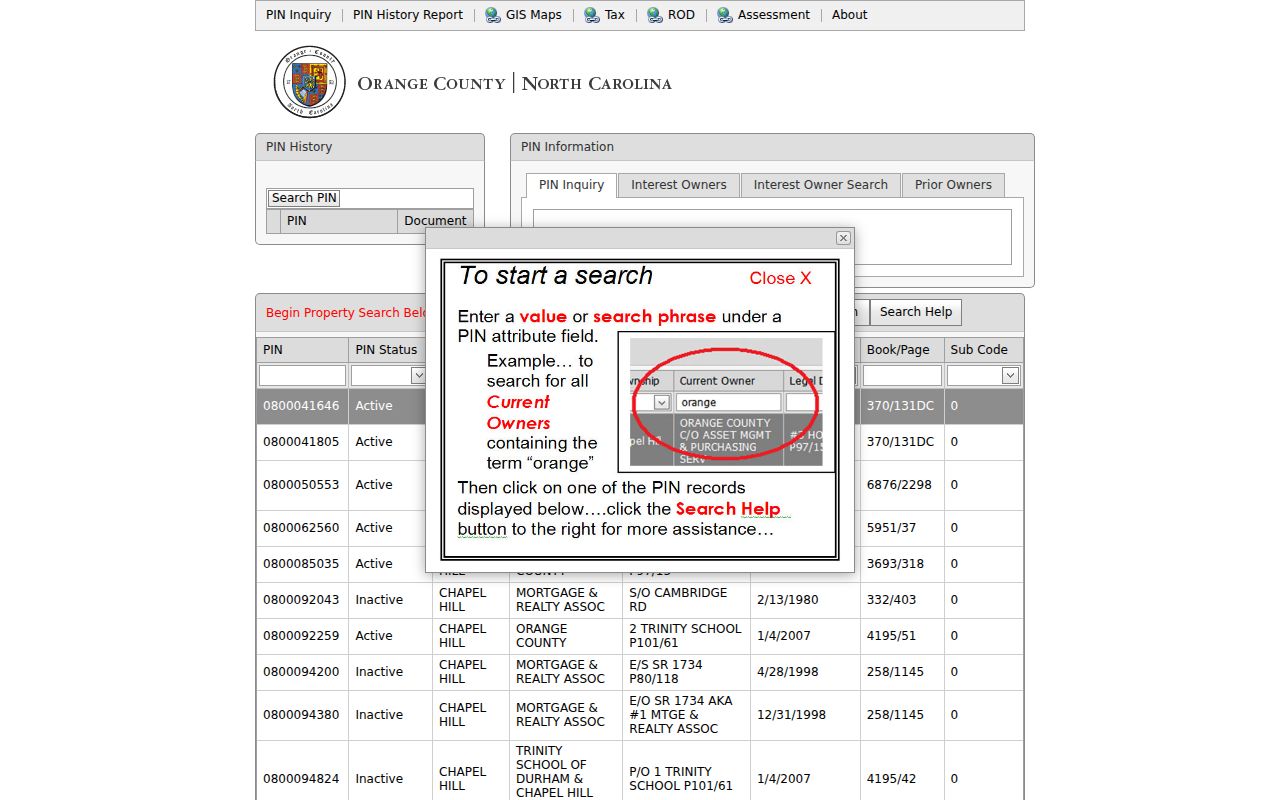
Once a match appears, carry the PIN and book and page into the deed index. A parcel record names an owner, not every occupant. Historical reverse directories, newspapers, and census sources can help identify who actually lived at the address.
Orange GIS adds owner name, parcel ID, NCPIN, physical address, and account searches. It can export selected results, show adjoining parcels, and move from a subdivision or street to nearby parcels. GIS boundaries are discovery aids, not survey evidence. For an eastern Chapel Hill parcel, switch to Durham's real-property system, which publishes the January 1 owner, values, an improvement photo, three years of sales, tax bill, and GIS links.
Search Chapel Hill Court Records
The statewide eCourts Portal searches by name, case number, attorney, citation, county, and other criteria. It can orient a search across Orange and Durham, but the authoritative paper file and certified copy remain with the clerk in the county where the case is kept. North Carolina completed the statewide eCourts rollout in all 100 counties on October 13, 2025. Older files and attachments may still require a terminal visit or retrieval request.
Orange courthouse self-service terminals add an important fallback. Criminal searches support defendant, case number, victim, or witness. Civil, special-proceeding, and estate matters are also available. The Chapel Hill courthouse branch at 179 E Franklin Street handles local sessions, while the main Orange Clerk office and paper files are in Hillsborough. Estate research requires an appointment with the Orange Estates office.
| Court route | What it covers | Best fallback |
|---|---|---|
| Orange District and Superior Courts | Orange civil, criminal, estates, divorce, and special proceedings | Hillsborough clerk terminal and paper file |
| Durham District and Superior Courts | Cases filed in the Durham portion | Durham clerk and county paper file |
| Middle District of North Carolina | Federal matters | PACER and federal clerk channels |
A docket is the court's event list, not proof that every claim was true. Read the final order or disposition, meaning the case outcome. Juvenile, adoption, sealed, expunged, and some sensitive family files are closed. A charge also does not prove a conviction.
Note: Portal discovery does not move the certified file away from the Orange or Durham clerk that holds it.
Chapel Hill Voter Record Snapshot
North Carolina's public voter lookup can return registration details, districts, polling place, an available sample ballot, absentee status information, and participation history. First and last names are required. A year of birth and county are optional match fields, and the status control includes Registered as well as Removed or Denied. Search both Orange and Durham when the person's Chapel Hill address falls near the county line.
The NCSBE Voter Search shows the fields used for the official match.
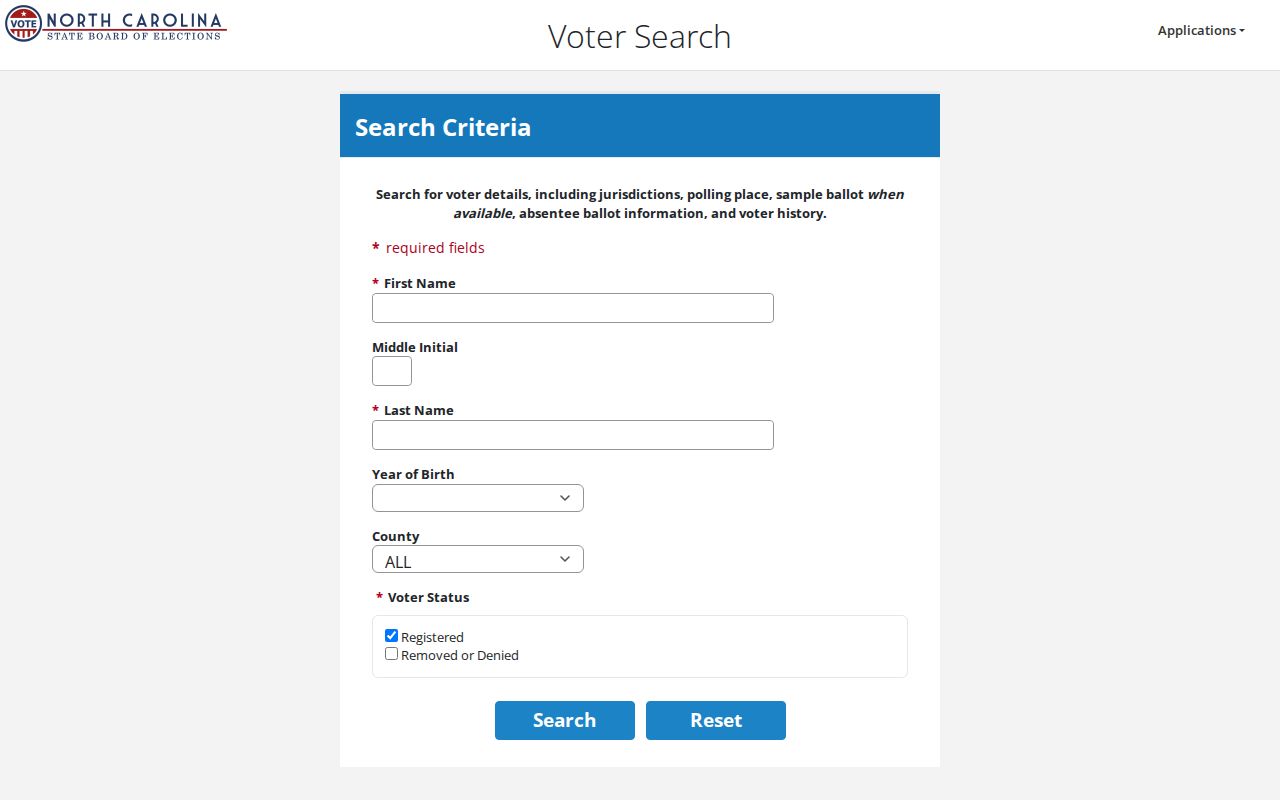
The result can confirm public registration geography and history, but it never reveals a ballot choice. Full date of birth, Social Security and driver-license numbers, election-law email, voter-ID images, and protected residential addresses remain confidential under G.S. 163-82.10. The complete field and file rules belong with the Chapel Hill voter records lookup.
Chapel Hill Vital Records Routes
For an event in Orange County, the Register of Deeds issues county birth, death, and marriage certificates. NC Vital Records offers the statewide route. A divorce decree comes from the clerk in the county that granted it, while the state divorce certificate only verifies the event. Durham County handles an event that occurred on the Durham side. County and state channels overlap, but they do not supply identical products.
North Carolina does not apply one simple closure period to every vital record. G.S. 130A-93 separates restricted birth identity fields, broader uncertified access, and eligibility for certified copies. Orange certified certificates cost $10. The mail form calls for the event facts, qualifying relationship or legal interest, identification, a self-addressed stamped envelope, and approved payment. The office says mail is processed within one to two business days after receipt.
State registration began in 1913. Earlier Chapel Hill births and deaths may require county registers, church records, cemetery files, newspapers, or the State Archives. Marriage certificates before statewide coverage began in 1962 remain county-first searches. Orange's FY2024-25 budget planned verification and indexing of death certificates from 1914 through 1925, but live coverage should be checked before relying on that work as complete.
Chapel Hill Genealogy Search Gateway
Chapel Hill Public Library connects current researchers with sources that reach far beyond modern portals. Ancestry Library Edition works in the building or on library Wi-Fi. HeritageQuest includes federal censuses from 1790 through 1940, family and local histories, and other primary sources. The digital Chapel Hill Weekly covers 1923 through 1972, while statewide historical newspaper access spans more than 1,000 county titles.
The library genealogy source gathers the main digital routes in one place.
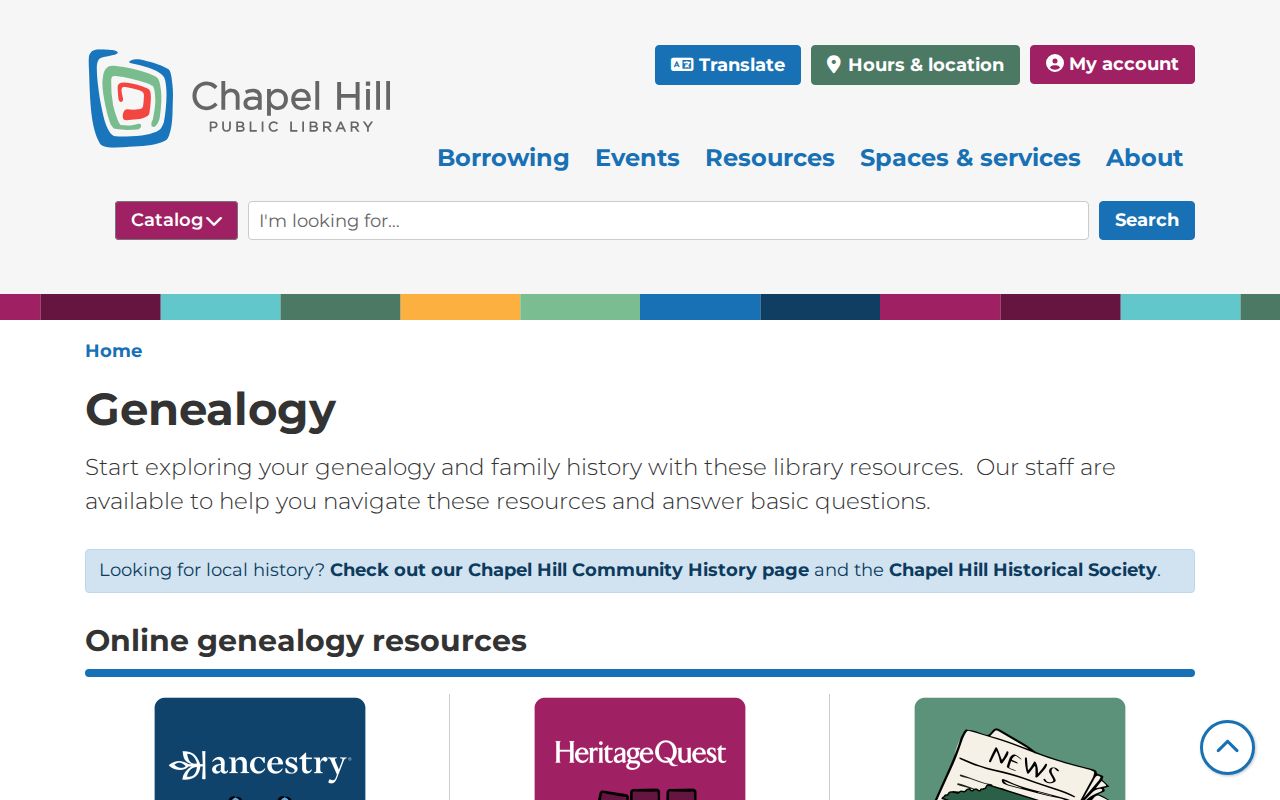
That screen is the web starting point, not the full historical boundary. Orange County Public Library in Hillsborough holds deed index microfilm from 1755 through 1962, deed books from 1775 through 1872, marriage bonds from 1752 through 1868, court minutes, wills, newspapers, maps, and journals. The State Archives Orange record group adds 2,762 reels plus physical and digital holdings.
Town and university records also miss parts of Chapel Hill's story. The Community History program collects Black, Indigenous, and other local memory overlooked by formal files. Oral history and cemetery field surveys are vital in Northside and other communities where segregation, lost markers, and directory bias left gaps.
Note: Chapel Hill Public Library and Orange County Public Library hold different research strengths, so an older search may need both.
Orange Records Lost Near Cornwallis
Orange County was formed in 1752, and surviving runs begin with court minutes, wills, marriage bonds, and an early deed index. Yet the State Archives catalog preserves a striking loss story. Some county records were reportedly hidden in woods as Cornwallis approached in 1781, then destroyed. The tale explains why a blank spot in one early series should not end a Chapel Hill family search.
Work around the gap with parallel evidence. Court minutes may name a dispute or estate. Deeds can repeat an older boundary or family relationship. Wills, tax lists, church registers, marriage bonds, and later newspaper notices may preserve facts that disappeared from the lost volume. A later instrument can also recite an earlier transfer. Record the source date and exact role of each person so that indirect evidence stays distinct from a surviving original.
Online deed coverage beginning in 1932 creates a similar modern illusion. Separate Old Index Books and library microfilm reach back much farther. Chapel Hill's record trail is layered, not broken at the edge of the current portal.
Chapel Hill Custody Records Check
For present Orange County custody, the Sheriff's current detainee list is the direct local source. It is a current roster, not a full statewide criminal history. The NC Department of Adult Correction separately searches prison, probation, and parole information, with historical data reaching 1972. Federal custody has its own locator. Always choose the system that matches the agency and time period.
The Orange County current detainees source publishes the active local list and a downloadable PDF.
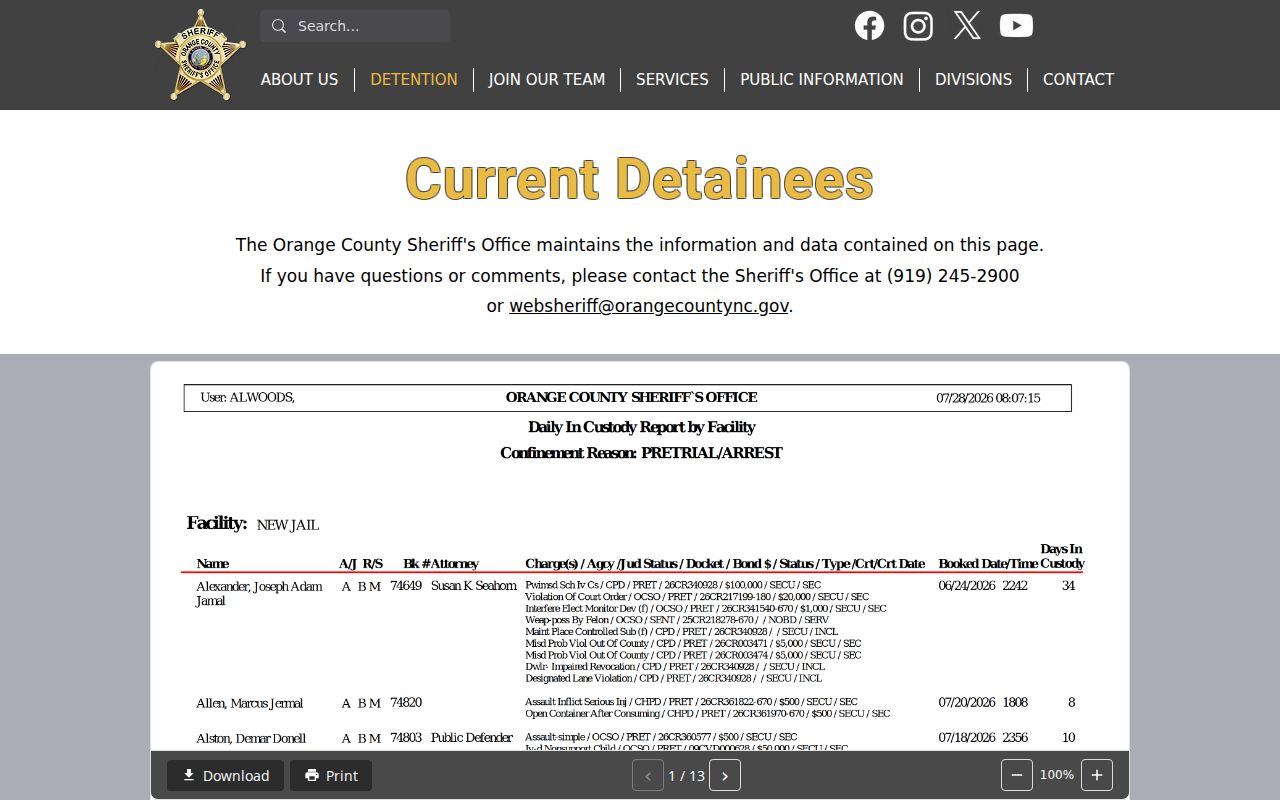
The roster can establish present custody under the source's update cycle. It cannot prove the final outcome of a charge. Follow a case number or name into eCourts, then read the disposition or ask the county clerk for the authoritative file.
Use records lawfully. Public access never permits stalking, threats, harassment, or harm. Protected addresses and sealed information must not be reconstructed from other sources.
Chapel Hill Unclaimed Property Search
North Carolina's official unclaimed-property database is a useful name-and-address lead. A record may connect an owner to a last known address reported by a business or agency. Search and claim are free. A match is not proof that two people with the same name are identical, and payment requires the claimant to complete the state's identity and ownership process.
The NCCASH official search is the no-cost state route.
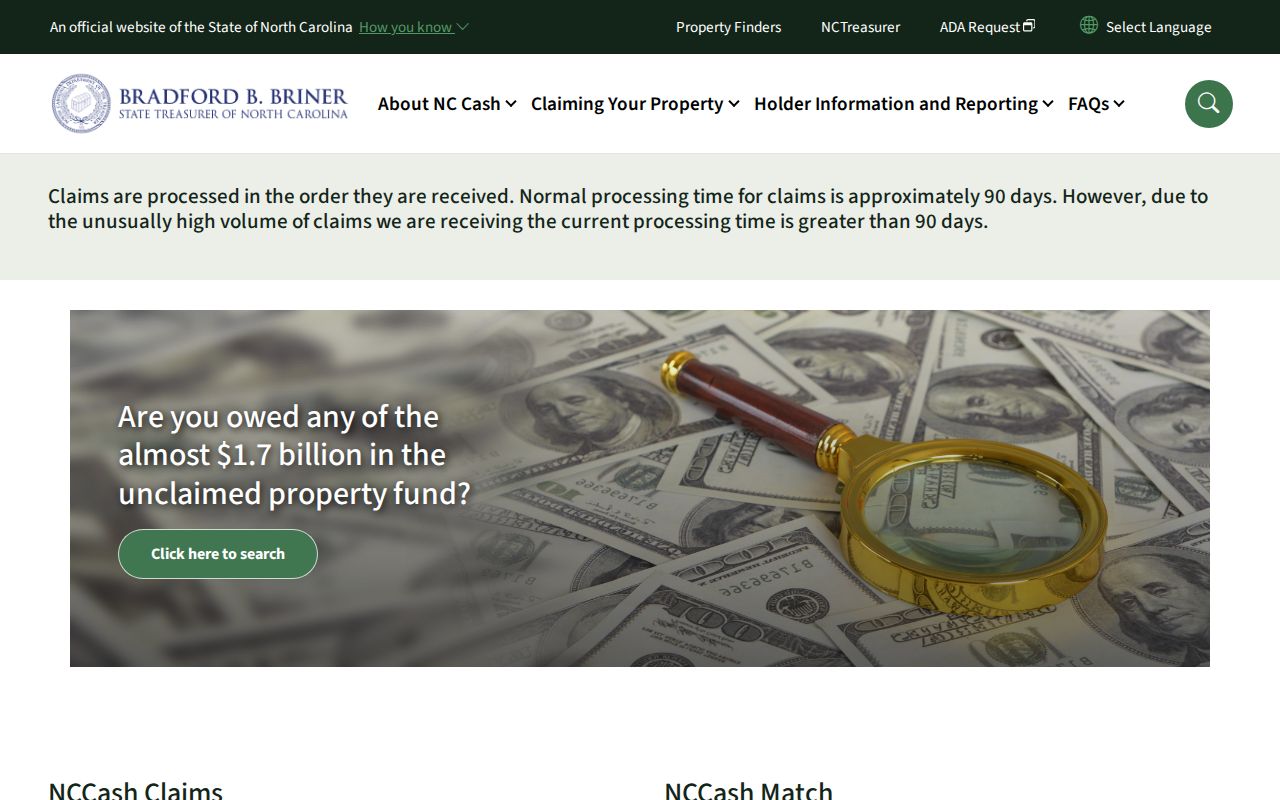
The official screen helps avoid paid solicitations that merely repackage public claim information. Compare the last known location with a deed, directory, estate file, or dated voter record before deciding that the result belongs to the intended Chapel Hill person.
Compare Chapel Hill Search Sources
Official sources and commercial compilations serve different roles. County and state indexes identify the custodian, recorded role, and date. A commercial people finder may combine public and private data into a convenient profile, but it can be stale, merged with another person, or detached from the source document. Use a compilation as a lead only, then return to the office record when accuracy matters.
| Source type | Strongest use | Main limit |
|---|---|---|
| Official web index | Locate a current citation or record role | May omit older books or attachments |
| Office terminal or paper file | Review authoritative details and obtain copies | May require travel, an appointment, or fees |
| Library or archive | Reach older directories, reels, newspapers, and county series | Catalog description may not include a digital image |
| Commercial compilation | Generate a broad starting lead | May charge, lag, or merge unrelated people |
Free does not always mean complete. Orange deed images, parcel searches, voter files, and current custody data are free online, but certified copies follow statutory fees. Historical work may require a reel or office book. A narrow request can be cheaper and faster than asking staff for every record tied to a broad surname.
Note: A web index identifies where to look; a certified record comes from the office that keeps the original.
Protect Chapel Hill Record Privacy
Public information can be corrected, masked, or restricted only through the rule that applies to that record. G.S. 132-1.10 provides a free written redaction route for listed identifiers on Register of Deeds or clerk web images. The request must identify the protected number, document, and exact image location. It removes the number from the online image, not the official instrument itself.
North Carolina's Address Confidentiality Program gives qualifying survivors a substitute Attorney General address for mail, voter registration, licensing, and utilities. It is a safety program with an application through a trained assistant, not a general preference opt-out. Voter protection can hide the residence while leaving the name, precinct, and other lawful registration data public.
A commercial listing may offer its own suppression form, but that act does not erase a deed, court docket, voter extract, or business filing at the source. A listing may return after new data is published. Correct a wrong official entry through the custodian, use each commercial provider's own privacy process, keep confirmations, and recheck later. North Carolina has no verified universal consumer-data deletion portal.
Request Missing Chapel Hill Search Records
North Carolina Public Records Law gives any person the right to inspect public agency records at reasonable times and obtain copies as promptly as possible. It sets no fixed statewide response-day count. The custodian may redact closed material from a mixed record, but an agency need not create a new analysis that it does not already maintain. Ordinary uncertified fees are based on actual reproduction cost unless another statute sets the charge.
Send the request to the office that keeps the record. Give the record type, date range, department, names, address, PIN, case number, or deed citation that applies. Chapel Hill Town Clerk handles municipal material. Orange NextRequest handles general county administrative records. Deeds and vital certificates go to the Register of Deeds, while case files go to the Clerk of Superior Court. Use Durham custodians for Durham-side events and parcels.
Search the published index and prior requests first. Electronic Chapel Hill fulfillment is generally free; town paper copies and staff research have a separate schedule. Orange's revised 2024 policy charges actual production cost for requests above 100 pages. A focused request can reduce delay and special-service work while giving staff enough detail to identify the existing record.
When no image exists, ask for the next verified channel: office terminal, paper file, mail order, library reel, State Archives series, or an appointment. That fallback chain reaches Chapel Hill records that no single online name search can hold.