
What Chapel Hill Public Records Reveal
North Carolina Public Records Law, N.C. Gen. Stat. Chapter 132, treats material made or received in public business as the people’s property unless another law protects it. Chapel Hill records therefore begin with a presumption of access, not a promise that every field or file is open. Deeds and tax ownership are broadly searchable. Court dockets, incident facts, vital certificates, and voter data have record-specific limits.
| Local record set | Keeper | Web route or span | Access path |
|---|---|---|---|
| Deeds, trusts, liens, plats | Orange or Durham Register of Deeds | Orange index from 09/01/1932; Durham has its own portal | Free index and images; office copy or certification |
| Property and tax | Orange Tax/GIS or Durham Tax | Current and prior owners; parcel maps | Free web search; tax or land-records office fallback |
| Civil, criminal, estate | County Clerk of Superior Court | Statewide eCourts Portal | Portal, courthouse terminal, paper file, certified copy |
| Birth, death, marriage | County Register of Deeds; NC Vital Records | County and state services differ | Inspection or uncertified route where allowed; eligibility for certified copies |
| Jail and correction | Orange Sheriff; NC DAC | Current detainees; state data to 1972 | Free web tools; agency records unit |
| Town agency files | Town Clerk or named department | Town request form and published report links | Electronic request, email, mail, or office contact |
Specific laws close juvenile, adoption, sealed, and expunged matters. The Driver’s Privacy Protection Act and G.S. 20-43.1 restrict motor-vehicle personal data. G.S. 132-1.4 withholds criminal investigation and intelligence files while leaving listed arrest and incident facts open. A protected field can be removed from a released copy while the rest is produced.
The General Assembly publishes the full text of Chapter 132. Its official presentation shows the controlling sections a requester can cite.
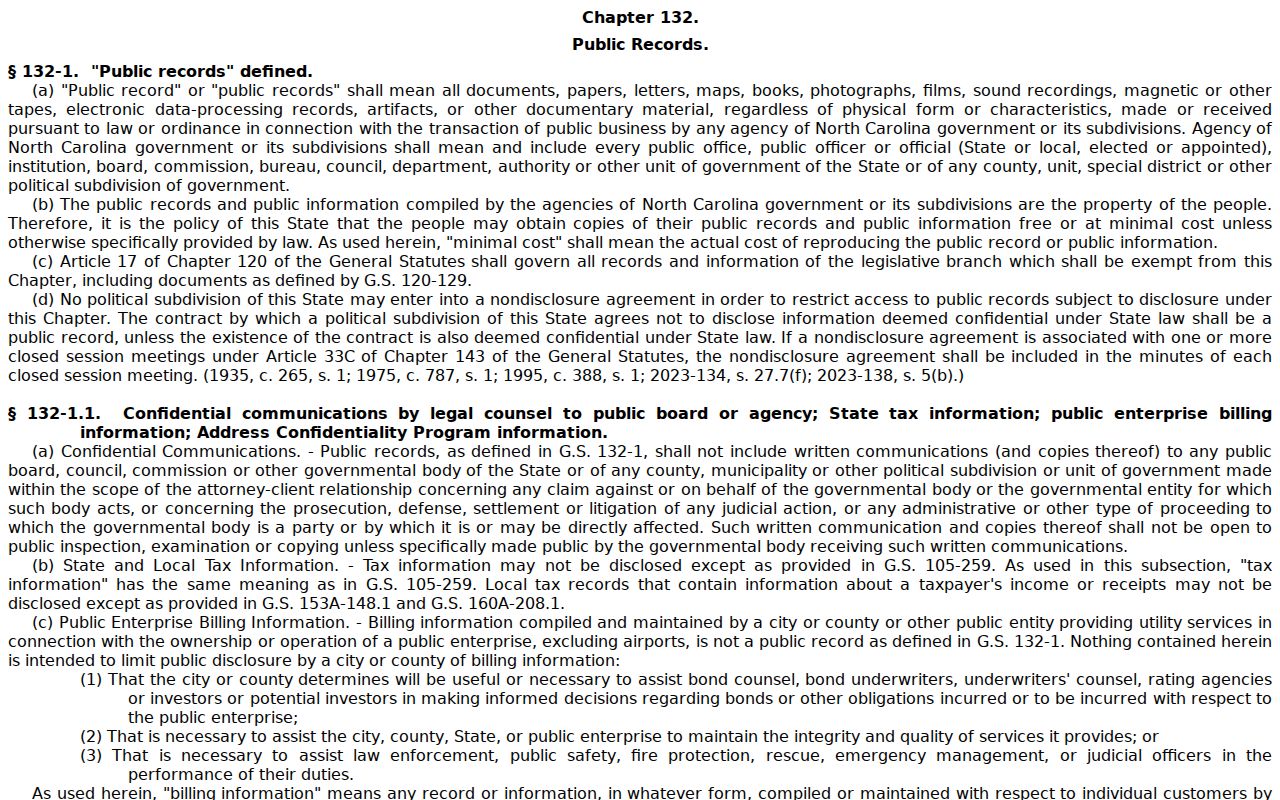
The statute is the starting point. A vital-record, court, police, utility, voter, or protected-address law may still control a particular field.
- Custodian
- The agency or official that keeps and answers for a record.
- Index
- A finding tool that lists filing details. An index entry is not always the document image.
- Certified copy
- A copy authenticated by the keeper for official proof, usually under a statutory fee.
- Exemption
- A law that withholds a record or field from ordinary access.
Chapel Hill Deed Records Since 1932
The Orange County Register of Deeds Consolidated Index was verified from September 1, 1932 through July 24, 2026. That date span is a measure of web coverage, not the age of Orange land records. Older Index Books remain a separate search mode, and deed-index microfilm at the Orange County Public Library reaches back to 1755. The Hillsborough office is the copy and certification fallback.
The Orange Register of Deeds gateway recommends Chrome or Edge and requires cookies and popups. Its controls are unusually rich, so a broad surname can be narrowed without inventing a party or sample result.
| Portal label | Control | Required | Verified choices or format |
|---|---|---|---|
| Last/Firm Name; First Name | Text | No | Surname or organization; individual given name |
| Party Role | Radio | No | Grantor; Grantee; Either |
| From Date / To Date | Date pair | No | Narrows recording date |
| Index Type | Radio/select | No | Mixed; Temporary |
| Party Type | Radio | No | Firm; Individual; Either |
| Name match | Choice | No | Begins With; Exact Match; Match Contains |
| Similar-name logic | Checkbox | No | Adv Similar Name; Soundex Similar Name |
| Symbols Only / Autosuggest | Control | No | Optional search behavior |
| Book Type; Document Type | Dropdown | No | Portal book classes and recorded instrument types |
| Tax From / Tax To | Numeric pair | No | Tax filter |
| Description / PIN; Doc # | Text | No | Legal description, parcel ID, or document number |
| Book / Page | Text pair | No | Direct citation lookup |
| Result Style | Radio | No | Traditional; Directory |
| Results per page | Dropdown | No | 15, 50, 100, 200, 500 |
| Print style | Choice | No | List Of Index Records; Document Details |
“Document Details” includes all details and parties, while “List Of Index Records” pairs one grantor with one grantee. A grantor transfers an interest; a grantee receives one. Neither label alone proves where either party lived. Ordinary Orange copies cost $0.15 per uncertified page or $5 for the first certified page plus $2 for each added page.
Note: Chapel Hill property east of the county line belongs in the Durham Register of Deeds system, even when the mailing city remains Chapel Hill.
Two Counties Shape Chapel Hill Records
Chapel Hill is not a county seat, and the town crosses a county line. Most local files route through Orange County offices in Hillsborough. A smaller eastern portion routes through Durham County offices in Durham. The relevant county is where the parcel lies, the event occurred, the license was issued, or the case was filed. A postal label does not settle custody.
For a Durham-side parcel, use the Durham Register of Deeds and Durham Real Property Search. Durham’s property system expressly offers the January 1 owner, land and improvement values, an improvement photo, three years of sales, tax bill, and GIS links. Its Register of Deeds counter is at 201 E Main Street and also handles deeds, trusts, plats, assumed names, notaries, and county vital records. Durham Fraud Guard is the verified recording-alert channel there; no equivalent Orange service was confirmed in the research.
County choice also changes the court clerk and vital-record keeper. The statewide court portal can expose a case filed in either county, but certification and the paper file stay with the filing clerk. A marriage certificate comes from the Register of Deeds that issued the license. Checking geography first prevents a false “no record” result.
Chapel Hill Property Records by PIN
Orange County’s PIN Management Web searches a property by official PIN, status, township, current owner, legal description, recorded date, book/page, or subdivision code. Tabs add Interest Owners, Interest Owner Search, Prior Owners, and a PIN History Report. The parcel identification number, or PIN, is tied to State Plane coordinates and is meant to stay with land even when an address changes.
The Orange County Interactive GIS adds map context and searches Owner Name, Parcel ID, NCPIN, Physical Address, or Account Number.
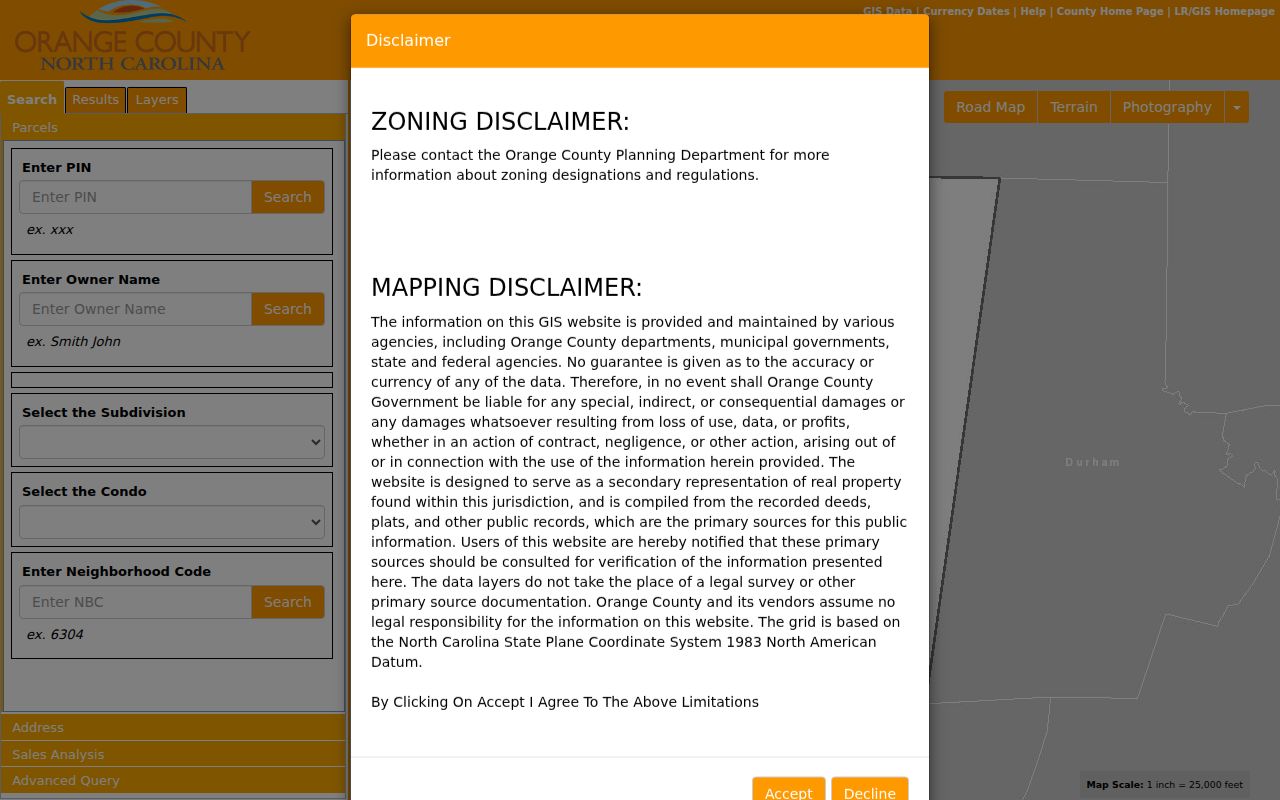
The GIS view can lead from an address to a parcel, adjacent land, and a book/page citation, but the county warns that the map is not survey quality.
Owner names are entered last name first without a comma. Selecting autocomplete creates a narrow match; pressing Enter can run a wildcard. Results can be exported to CSV, with a selection cap of 2,500. Office staff can help or print maps when the web tool fails. For title proof, carry the PIN or book/page into the deed index and order the recorded instrument.
Note: GIS maps help locate a parcel, but only the recorded deed and custodian copy establish the filed land instrument.
Chapel Hill Court Records Access
The North Carolina eCourts Portal searches by name, case number, attorney, citation number, county, and other criteria. It became available statewide in all 100 counties on October 13, 2025. That makes discovery more uniform, but not custody. Orange files remain with the Orange County Clerk of Superior Court, and Durham files remain with the Durham clerk.
When the web result is thin, public self-service terminals provide a second channel. Criminal terminals support defendant name, case number, victim name, or witness name. Civil, estate, and special-proceeding searches are also available. A terminal may permit free viewing or emailing. The paper file and certified copy come from the clerk in the county where the case sits.
An open docket may show parties, a file number, case type, filing activity, counsel, and disposition when available. It does not establish liability or guilt by itself. Juvenile, adoption, sealed, and expunged matters are restricted. Copies cost $2 for the first page of a document plus $0.25 for each added page; a certificate under seal costs $3. A certified single-county criminal name search is a distinct $25 service.
Chapel Hill Vital Records Channels
North Carolina does not simply close every birth record for a century. G.S. 130A-93 separates protected birth identity fields, inspection, uncertified material, and eligibility for a certified copy. G.S. 130A-99 permits inspection and uncertified county copies or abstracts within its limits. The 100-year rule in Chapter 132 is a backstop with exceptions, not the day-to-day certificate rule.
For an Orange County birth, death, or marriage, the Register of Deeds accepts the event-specific form at the counter or by mail. A mailed request needs valid identification, a self-addressed stamped envelope, and approved payment. The form allows the subject, spouse, sibling, direct ancestor or descendant, step-relations, listed representatives, and certain legal-interest requesters to seek certified copies. Orange charges $10 and reports mail processing within one to two business days after receipt.
NC Vital Records is the statewide route and may cost up to $24 for a routine first copy or search. It manages state registrations beginning in 1913 and marriage certificates from 1962 forward. A divorce decree comes from the county clerk that granted it, while the state product verifies the event. For older events, use county registers, church and cemetery sources, marriage bonds, local microfilm, and State Archives holdings.
Note: An index or uncertified abstract can aid research, but it does not carry the authentication of a certified copy.
Where Chapel Hill Records Survived
Orange County began in 1752. The State Archives catalog reports that some county records were hidden in woods as Cornwallis approached in 1781 and were destroyed. That loss explains why an early name can disappear from one series but survive in another. Court minutes, wills, marriage bonds, deeds, tax lists, church registers, and newspapers must be compared rather than treated as one complete ledger.
The Rebecca B. Wall Local History Collection in Hillsborough supplies the chief local fallback outside the courthouse.
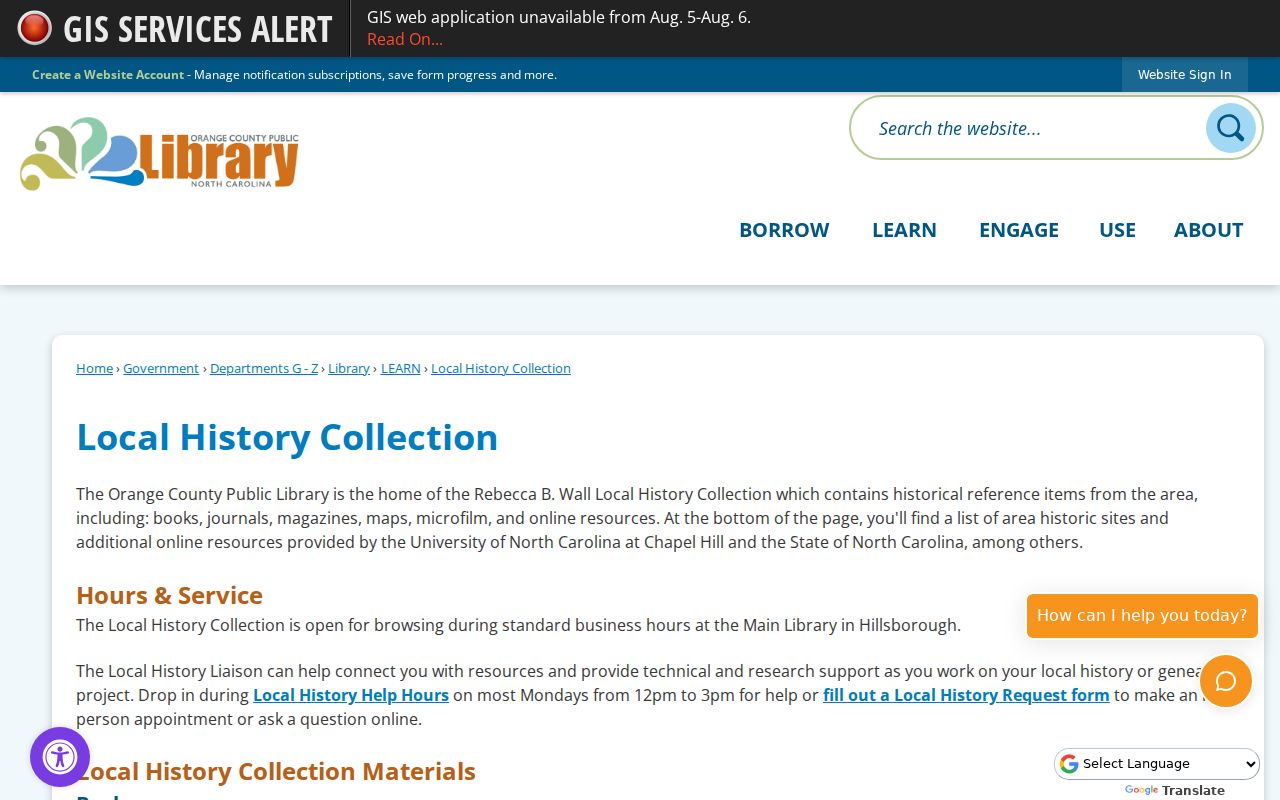
Its microfilm covers court minutes from 1752 to 1868, deed indexes from 1755 to 1962, wills, marriage bonds, deed books, federal census schedules, and county newspapers from 1820 onward.
The State Archives Orange record group includes 2,762 reels plus physical and digital holdings. Its scale is a useful warning: the modern web index is not the county’s historical boundary. Record a series, year, book/page, box, or reel before seeking staff help. For proof, return to the official custodian when a certified version exists.
Chapel Hill Public Record Custodians
Three Orange County offices handle most Chapel Hill requests, but their functions do not overlap. The Register of Deeds keeps land instruments and local certificates. Tax Administration maintains parcel and assessment data. The Clerk of Superior Court holds court, estate, divorce, foreclosure, judgment, and special-proceeding files. Sending a request to the wrong office delays it and can produce an incomplete answer.
Orange Register of Deeds
228 S Churton Street, Suite 300
Hillsborough, NC
919-245-2675
Monday–Friday 8–5
Deed and vital gateway
Orange Tax Administration
228 S Churton Street, Suite 200
Hillsborough, NC
919-245-2100
Monday–Friday 8–5
Orange Clerk of Superior Court
106 E Margaret Lane
Hillsborough, NC
919-644-4500
Estate visits require an appointment
Chapel Hill Town Clerk
Town departments and municipal files
allclerk@townofchapelhill.org
Request by web form or email
Estates staff do not take walk-ins; appointments use 919-644-4570 or estates.orange@nccourts.org. Chapel Hill branch court sessions at 179 E Franklin Street do not move the main Orange paper-file custody away from the county clerk.
Chapel Hill Records Request Costs
Town electronic fulfillment is normally free. Paper copies cost $0.18 per black-and-white page or $0.24 per color page. If Town staff research exceeds four hours, the rate is $25 per hour. Orange County revised its general administrative policy in July 2024 and begins charging actual production costs after 100 pages. Orange electronic production is $0.02 per page beyond the threshold. Black hard-copy rates are $0.05, $0.06, or $0.07 by supported page size; color rates are $0.10, $0.11, or $0.12. These administrative rates do not replace the separate Register of Deeds, court, vital, or election schedules.
The Orange County NextRequest portal accepts county administrative requests and lets readers inspect prior requests.
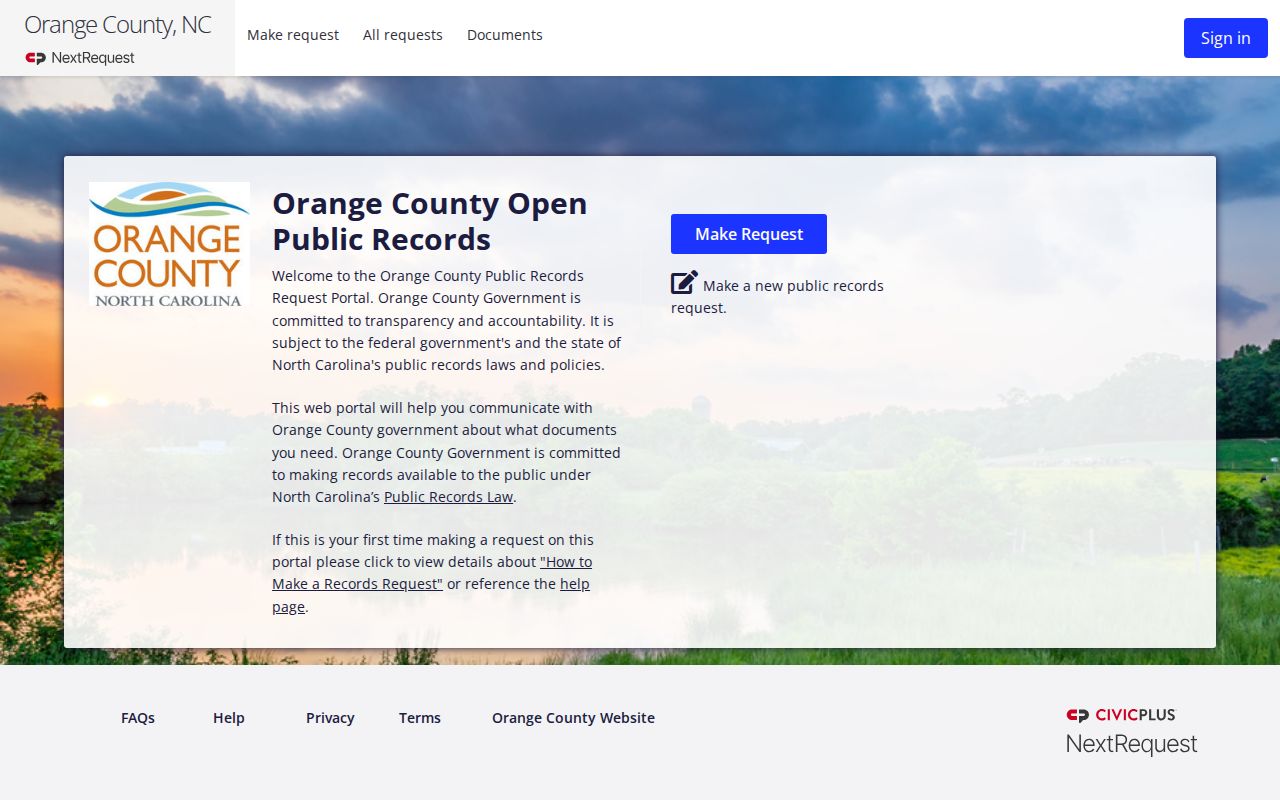
The portal centralizes county administration, but it should not receive a deed copy order, court-file request, or certified vital application.
Chapter 132 generally limits uncertified charges to actual reproduction cost unless another statute controls. A large request may carry a reasonable special-service charge tied to actual clerical, supervisory, or technical work. The agency need not create an analysis or compile a record it does not maintain.
Note: Ask for a cost estimate before approving a large request, especially when staff research or more than 100 pages may be involved.
Request Chapel Hill Public Records
Any person may inspect open North Carolina government material at reasonable times and under reasonable supervision. A requester need not state a motive. The custodian must furnish copies “as promptly as possible,” but Chapter 132 sets no general fixed number of response days. A useful request names an existing record with enough detail to locate it.
- Identify the exact custodian and county. Town departments, Registers of Deeds, court clerks, and county administration keep separate files.
- Check the relevant index or prior-request portal. Save a case number, PIN, book/page, document number, date range, or department name.
- Describe the record, preferred medium, and known identifiers. Avoid asking staff to create a report or legal conclusion.
- Submit through the office’s portal, email, mail, or counter. Database requests may be required in writing.
- Review any fee estimate and narrow the scope if needed. Certification uses the keeper’s statutory schedule.
- Ask for the legal basis of a denial. The agency must separate open material from protected content when possible.
- If access still fails, G.S. 132-9 provides civil enforcement and potential attorney-fee relief under its conditions.
Lawful personal use. Open records may support genealogy, estate work, civic review, or scam checks. North Carolina law can punish repeated surveillance, threats, stalking, or harassment without legal purpose.
For a deed, supply the party name, approximate date, PIN, type, or book/page. For a court item, give the county, party, case number, and document. A vital application needs relationship or legal-interest proof, identification, and the proper payment. Narrow facts help the custodian answer faster.
Chapel Hill Police Record Boundaries
A public incident fact is not the same as an open investigation file. Under G.S. 132-1.4, the public set can include the time, date, location, and nature of a reported violation, plus listed information about an arrested, charged, or indicted person. Investigation and intelligence material remains outside the ordinary access rule.
Chapel Hill Police links accident, incident, and arrest reports through the Town records channel. Its Records Division operates Monday through Friday, 8:30–5, at 919-968-2846. A Chapel Hill arrest check covers Chapel Hill Police arrests within town limits. County court records through the Clerk provide the broader filing and disposition trail.
The Orange Sheriff current-detainee list reports present local custody. The NC Department of Adult Correction search covers state prison, probation, parole, and inactive records with filters for status, name, offender number, gender, race, ethnic group, birth date, and age range. Neither source proves a final court outcome. Body and dash recordings use the special process in G.S. 132-1.4A, not a generic disclosure request.
Protecting Data in Chapel Hill Records
G.S. 132-1.10 allows a free written request to redact listed identifiers from Register of Deeds or clerk website images. The request must name the protected number, the document, and its exact image location. Covered data include Social Security and employer tax numbers, driver or state ID and passport numbers, financial account or card numbers, PINs, and passwords. The official instrument remains; the web image is redacted.
North Carolina’s Address Confidentiality Program under Chapter 15C gives qualifying survivors a substitute Attorney General address for mail and selected public transactions. Actual address and phone information receive protection under G.S. 132-1.1. The program requires safety-based eligibility and prospective planning with a trained application assistant. It is not a broad preference opt-out.
North Carolina has no verified comprehensive consumer-data law that creates a universal data-broker deletion portal. House Bill 462 from 2025 was proposed, not enacted. Removing a commercial listing also does not erase a lawful deed, docket, or tax roll. Corrections and statutory redactions must go to the source custodian, while deceptive data practices can be reported through North Carolina Department of Justice consumer resources.