
Search Chapel Hill Voter Registration
Use the North Carolina State Board of Elections Voter Search when checking one person. The form requires a first name, last name, and at least one status choice. A middle initial, birth year, and county can narrow a common name. Select Orange County for most Chapel Hill addresses, but try Durham County when the home lies in the town's eastern section. The postal city alone does not settle which county keeps the registration.
JavaScript must be enabled. Start with the name as registered, choose “Registered,” and add the county. If that is too narrow, remove the county before changing the spelling. Then check “Removed or Denied” when an older or incomplete record is the goal. The lookup is a person-by-person verification tool. The downloadable files described later are the practical route for broader voter roll research.
| Lookup control | Input | Required | How to use it |
|---|---|---|---|
| First Name | Text | Yes | Enter the registered given name. |
| Middle Initial | Text | No | Use to separate similar names. |
| Last Name | Text | Yes | Enter the registered surname. |
| Year of Birth | Dropdown | No | Choose a year, not a full birth date. |
| County | Dropdown | No | Use Orange or Durham for Chapel Hill. |
| Voter Status | Checkboxes | Yes | Select Registered and/or Removed or Denied. |
The official North Carolina Voter Search shows the fields above before a query. Its result can supply registration details, districts, polling place, an available sample ballot, absentee information, and voter history. It does not publish a ballot selection. A failed match is not proof that no record exists; spelling, county, review masking, status, or a recent update can affect the result.
Chapel Hill Voter Lookup Results
A lookup result joins several kinds of election data. Registration details identify the matched voter and current status. Jurisdiction lines show the precinct and districts tied to the residence. Polling-place information tells where that voter is assigned, while a sample-ballot link appears when one is available. Participation history records the election and method of voting. These are administrative facts, not a view inside the ballot box.
The Orange County Board of Elections page is the local fallback for most Chapel Hill registrations.
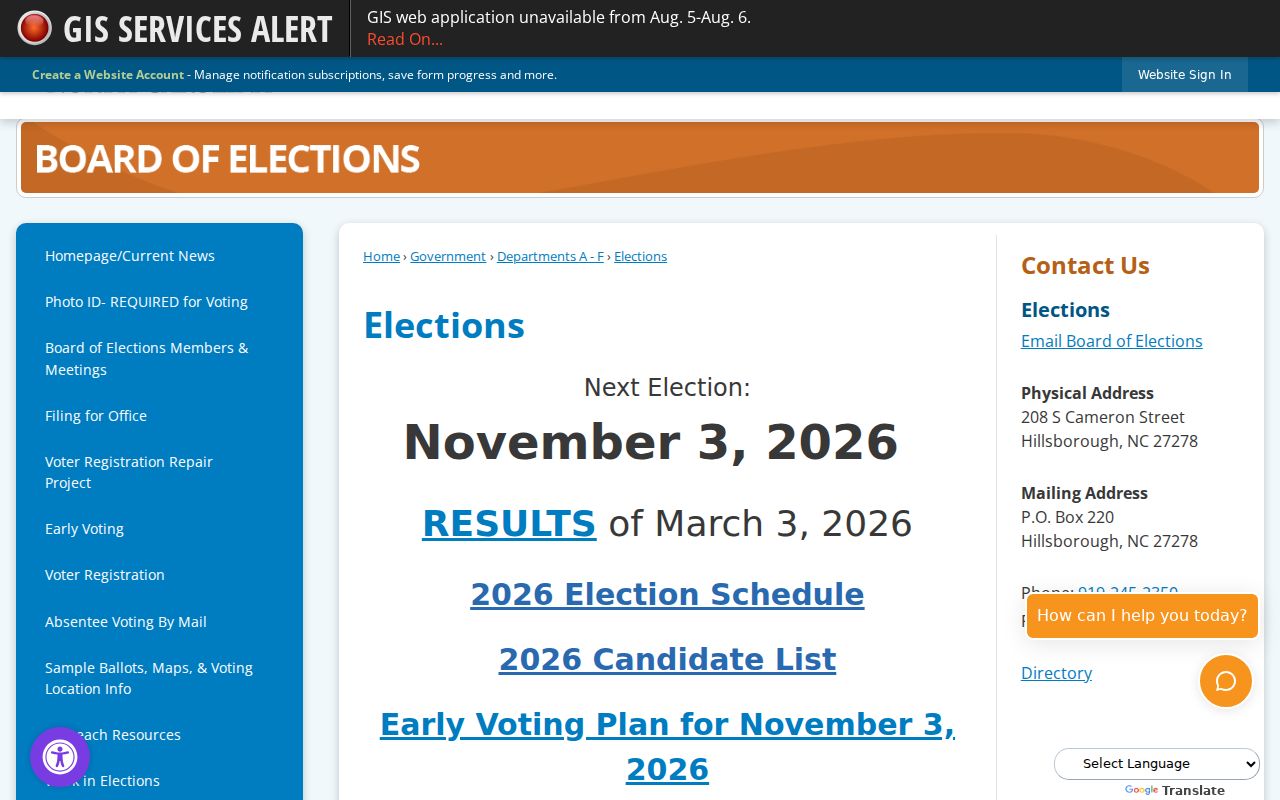
The office page connects local voters with registration, election, and results services. It also identifies the county custodian to contact when the statewide result seems stale or does not resolve a Chapel Hill address.
Read residence and mailing addresses as distinct fields. The residence assigns precincts and districts, but the mailing address may differ. Chapel Hill municipal elections are nonpartisan and at large, so a result need not list a city ward. Party affiliation states the registration choice only. It cannot establish how the person voted.
Note: A current eligibility question belongs with the county board because weekly and online records may lag a local transaction.
Public Chapel Hill Voter Fields
The statewide current file is much richer than a single lookup result. It includes active, former, attempted, and incomplete registration records. Status and reason codes must be read together, because presence in the download does not always mean the voter is currently eligible. A `#` in a name or registration-date field means the county is reviewing it to avoid releasing wrong or confidential information. Do not try to reconstruct a masked value.
| Identity | County voter number, NCID, last, first, middle, and suffix. |
|---|---|
| Status | Code, description, reason code, and reason description. |
| Addresses | Residential and mailing fields, except when protection applies. |
| Registration | Registration date, party, race, ethnicity, gender, birth year, age at year end, and birth state. |
| Verification | Yes/no indicators for identifying information supplied, never the number itself. |
| Districts | Precinct, municipality, legislative, judicial, school, service, township, and other election geography. |
The file may show a public phone number when one was supplied. It also includes a confidentiality indicator. Birth year and age at year end are public file fields, but the full birth date is not. Driver-license and Social Security columns are only flags that say whether identifying information was supplied or whether further identification is required.
Confidential Chapel Hill Voter Data
North Carolina draws a field-by-field line rather than closing an entire registration. The public can see many facts needed to administer elections, yet sensitive identifiers remain withheld. A signature may be viewed under the law, but it cannot be copied or traced outside election administration. Protected-address rules add a second layer for voters facing a documented safety risk.
The official text of G.S. 163-82.10 sets out that split.
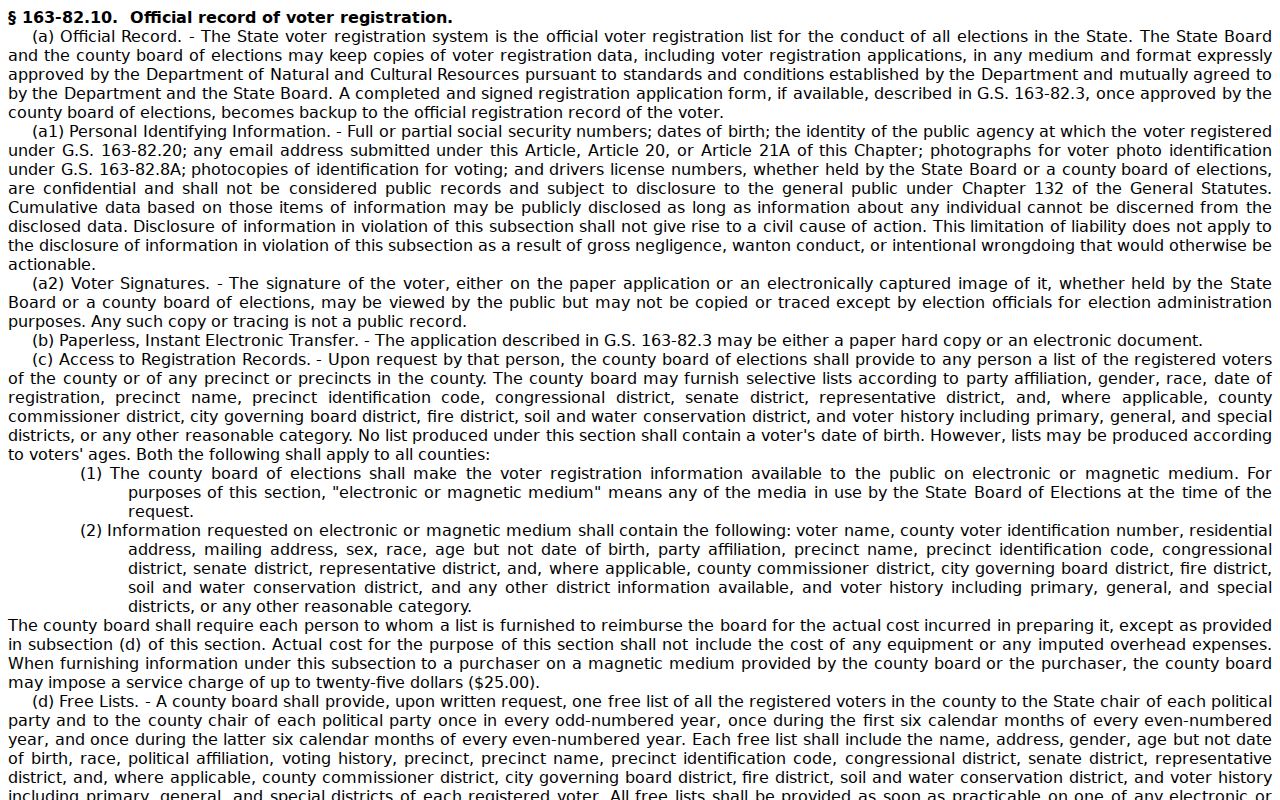
The statute is the controlling source for public fields, custom lists, fees, signatures, and protected residences. Chapter 132 provides the broader public-record framework, but it does not override this election-specific rule.
Confidential by North Carolina law. Full or partial Social Security numbers, full birth dates, driver-license numbers, voter-ID images, election-law email addresses, and the identity of a registration agency are withheld. A qualifying protective order or Chapter 15C Address Confidentiality Program card plus a signed safety statement can also shield the residence address.
A protected record can still disclose the voter’s name, precinct, and other public registration data. The actual residence remains available only for authorized administrative, court, or law-enforcement use. Respect the confidentiality indicator and any masking. Moving to another released database to infer the protected address defeats the purpose of the safety rule.
Orange Voter Rolls and Fallbacks
The Orange County Board of Elections processes and maintains registrations for most Chapel Hill voters. Call 919-245-2350 or email vote@orangecountync.gov when a voter search conflicts with a recent application, move, status notice, or election-day assignment. Research found a relocation notice tied to temporary space, so the current street office should be confirmed before an in-person visit. That gap makes phone or email the sound first step.
For the smaller Durham County portion of Chapel Hill, contact the Durham election authority instead of asking Orange to resolve a record it does not hold. At the state level, NCSBE can be reached at PO Box 27255, Raleigh, NC 27611-7255, by phone at 919-814-0700, fax at 919-715-0135, or elections.sboe@ncsbe.gov. These channels matter when a statewide file, county transaction, and online result differ.
Note: A Chapel Hill mailing label does not prove Orange County custody; confirm the county before requesting a local list.
Chapel Hill Voter Status Changes
North Carolina’s file uses A for active, D for denied, I for inactive, R for removed, and S for temporary military or overseas status. The paired reason field supplies essential context. County maintenance can draw on death information, a signed notice from a near relative or personal representative, felony-conviction data with notice and a chance to object, county moves, and federal address-confirmation procedures.
Inactive does not mean cancelled after one missed election. A voter who does not respond to an address-confirmation notice is removed only after no voting or appearance through the second federal general election following that notice. This is an important local research limit. Treat the status as an administrative state on the file date, not as proof of residence on every earlier or later date.
Removed voters also age out of the current extract. North Carolina omits them when the most recent last-voted date is more than ten years old. Historical snapshots, available for more than fifteen years, may preserve an earlier status, but they do not promise a permanent row for each former Chapel Hill resident.
Voter History Preserves Ballot Secrecy
Voter history is a separate dataset. It can include the election, county where the ballot was cast, precinct, voting method, county registration number, NCID, and coded party or precinct information. The files cover participation entries for the prior ten years. They omit names and demographics, though an NCID or county voter number can connect a history row to the public registration file.
The NCSBE voter history download page supplies the official file instructions.
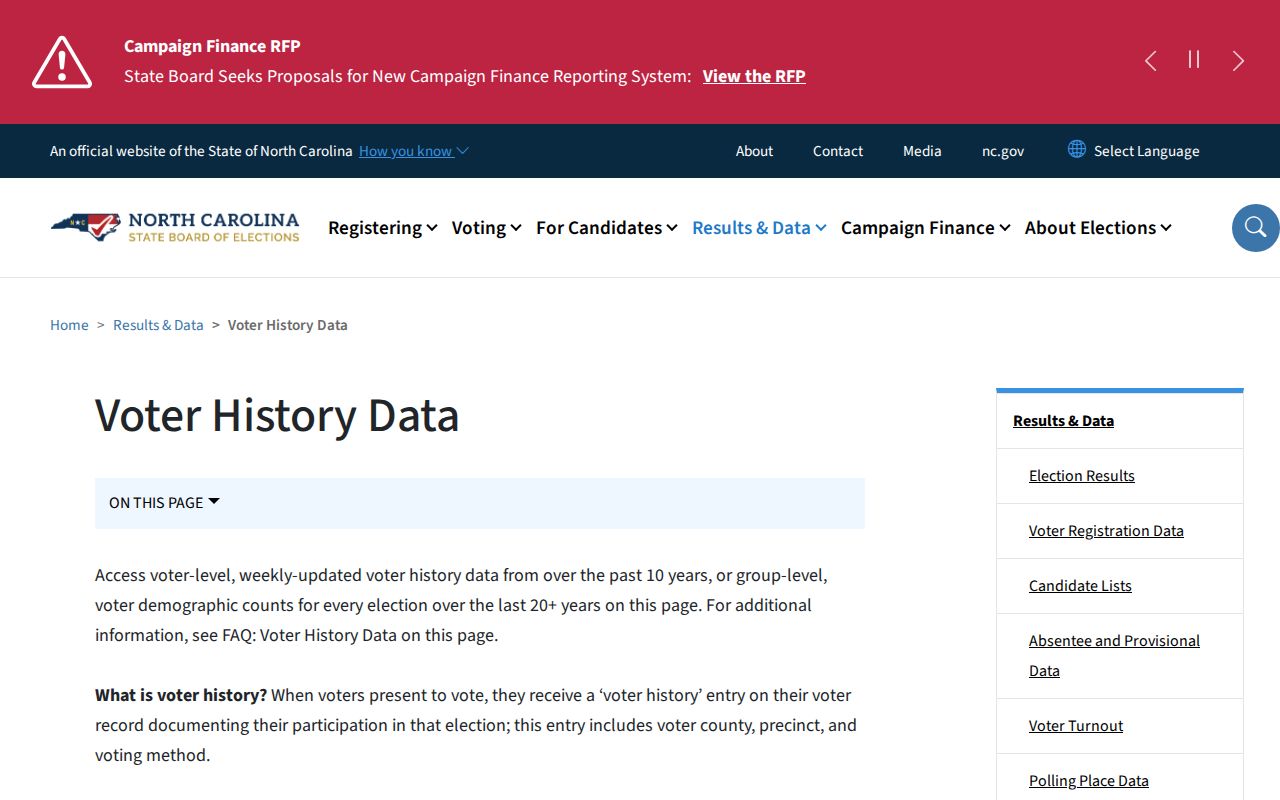
The download channel separates the fact of participation from the registration extract. Voting method may distinguish Election Day, absentee by mail, or another coded method, but neither file identifies a candidate, contest selection, or ballot choice.
Lawful use matters. Public availability does not permit stalking, threats, or repeated surveillance. G.S. 14-277.3A covers a willful course of conduct without legal purpose that causes fear for safety or substantial emotional distress; cyberstalking rules may also apply.
Statewide History Fixes County Drift
A subtle file rule can change past-election research. A county voter-history extract follows the voter’s current county, not always the county where the person participated in an older election. Someone who voted in Orange County and later moved to Durham County may therefore be absent from the Orange-only history file for that earlier event.
NCSBE’s practical fix is to download the statewide voter-history file and filter the `voted_county_desc` field for the county where the vote occurred. This keeps the event geography separate from current registration geography. It is especially useful around Chapel Hill, where a move across the Orange-Durham line may keep the same city name while changing the election custodian.
Even then, a history match proves participation only. Use NCID or county voter number carefully, retain the file date, and do not infer any ballot selection. Group-level election history reaches beyond twenty years, but it is not a person-by-person substitute for older participation rows.
Obtain North Carolina Voter Files
Most requests should begin with the free statewide data page. NCSBE publishes county ZIP files and a statewide ZIP file, refreshed on Sunday evenings, along with historical snapshots and a field layout. Download Orange and Durham when researching Chapel Hill across the county line. A Sunday file can lag a county transaction or post-election finalization, so it is a research snapshot rather than real-time certification.
The NCSBE voter registration data page is the direct download source.
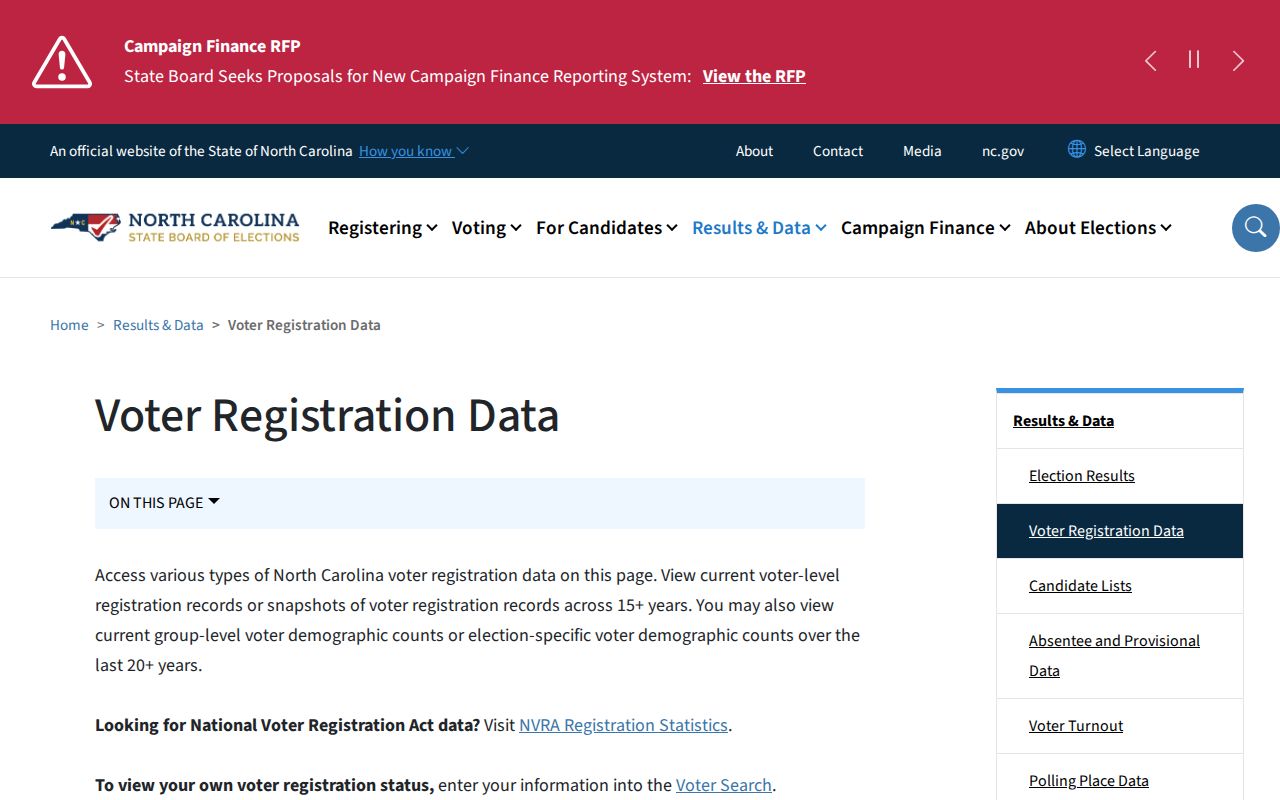
The page offers the standard files without a custom request or preparation charge. Its official layout is the key to decoding status, reason, district, verification, and confidentiality columns.
- Choose the free county or statewide registration ZIP and save its published file date. Use both Orange and Durham county data when the Chapel Hill address side is uncertain.
- Read the official field layout before filtering. Keep status, reason, county, public address, confidentiality indicator, and district fields in context.
- Request a custom list only when the free file does not meet the need. Send the county board a written description of geography, fields, filters, file format, and delivery medium.
Any person may request a county list or selected precinct list under G.S. 163-82.10. Available categories can include party, gender, race, registration date, precinct, districts, and voter history. The charge is the actual preparation cost, and magnetic media may carry a service fee of up to $25. Imputed overhead and equipment costs are excluded. No current standalone Orange request form was verified, so a clear written request to the board is the documented fallback.
Historical Chapel Hill Voter Records
Modern downloads do not define the full historical record. NCSBE provides long-running snapshots and aggregate election statistics, but current extracts eventually drop older removed voters. For earlier work, search State Archives and county library catalogs for poll books, registration registers, election returns, and related county series. Orange County’s broader archival trail begins in the eighteenth century, yet the research did not verify exact Chapel Hill poll-book or register years.
That gap should remain visible. Do not assign an invented date run to a catalog series. Start with the person’s date, address, county, and precinct if known. Then ask the State Archives search room or the relevant county library whether a named election record survives on paper or microfilm. Chapel Hill’s county split still controls: an event tied to the Durham side belongs in Durham’s record chain.
Historical participation also requires restraint. A registration or poll-book entry can document administrative eligibility or attendance in an election process. It still cannot reveal a marked ballot. Pair any old entry with directories, deeds, or census records only to confirm identity, never to assign a private political choice.